Pergola vs. Patio Cover: Which One Is Right for Your Dallas Backyard?
Your Complete Guide to Making the Right Choice
If you're standing in your backyard right now, imagining what could be, you've probably asked yourself this question: Should I get a pergola or a patio cover?
It's one of the most common questions I hear from homeowners in Dallas-Fort Worth. And honestly? It makes sense that you're confused. At first glance, they seem pretty similar—both create shade, both extend your living space, both look beautiful.
But the truth is, they're actually quite different. And choosing the wrong one can mean the difference between a space you use every single day and one that sits empty for most of the year.
So let's break this down together. No sales pitch, no jargon—just an honest conversation about what each option really offers and how to figure out which one fits your life.
What Exactly Is a Pergola?
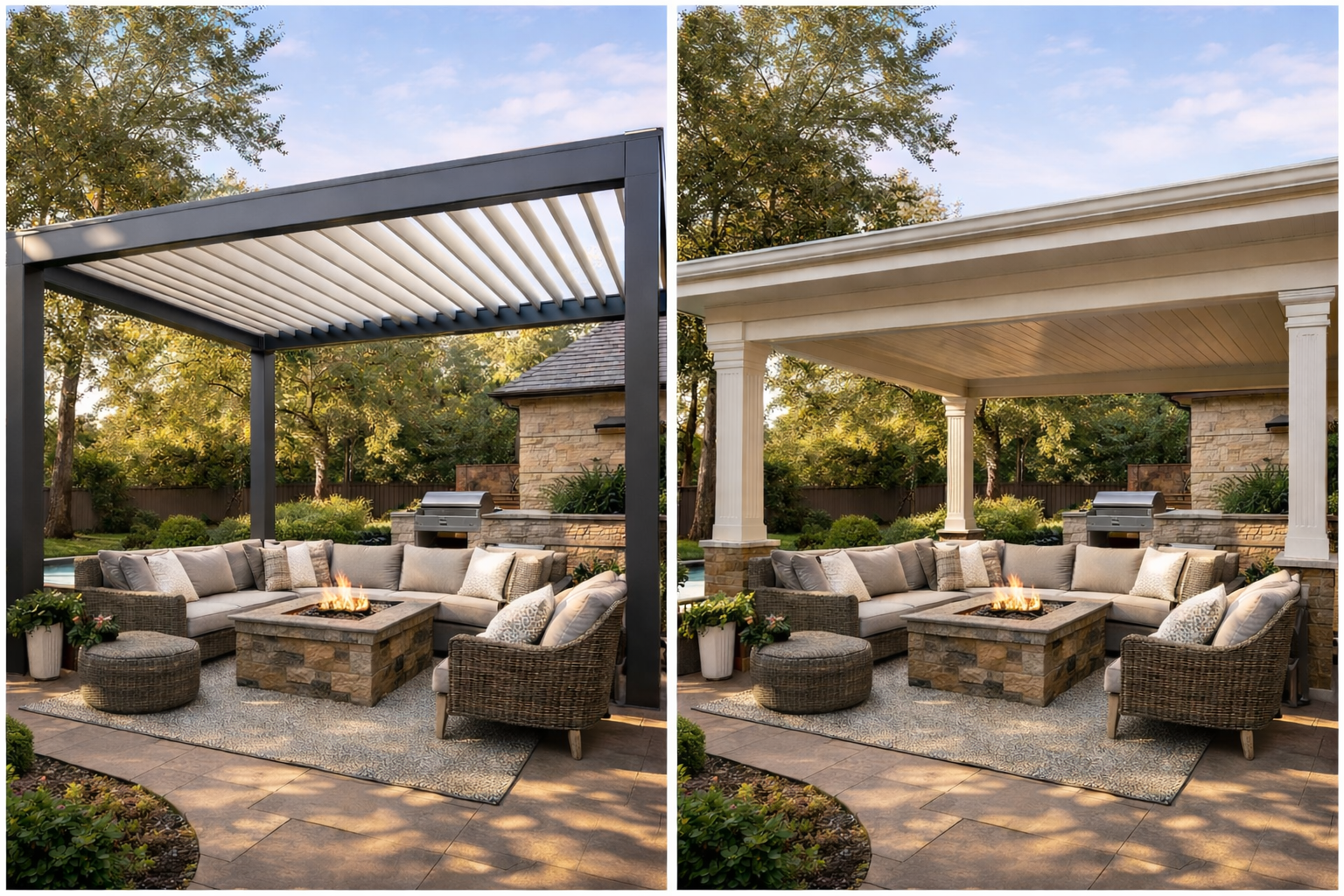
Let's start with the basics. A pergola is an outdoor structure with vertical posts that support cross-beams and an open lattice roof. Think of it as a partial roof—it provides some shade through the slats or beams on top, but it's not fully covered.
Traditional pergolas have fixed slats or beams that create a beautiful pattern of light and shadow underneath. They're gorgeous, architectural, and they add instant structure to any outdoor space.
Modern motorized pergolas (like the ones we install at Goodlux) take this concept further. The louvers on the roof can open and close, giving you complete control over how much sun, shade, or even rain protection you want at any given moment.
What Makes a Pergola Special
Here's what a pergola brings to your backyard:
Flexibility and control. With a motorized pergola, you're not stuck with one setting. Want full sun in the morning? Open the louvers. Need complete shade for lunch? Close them. Want to see the stars at night? Open them back up. You decide.
Year-round usability. This is the big one. Because you can close the louvers completely, you get real protection from rain and harsh sun. That means your outdoor plans don't get canceled when the weather turns.
Architectural beauty. There's something about the clean lines of a pergola that just elevates a space. It creates definition in your backyard without making it feel closed in or dark.
Light and airflow. Even when closed, a pergola maintains better ventilation than a solid patio cover. You get protection without feeling stuffy or enclosed.
Customization. Modern pergolas can include integrated lighting, heating, fans, screens, and even retractable walls. They can truly become a full outdoor room that you control.
Where Pergolas Shine
Pergolas are perfect if you:
Want flexibility in your outdoor space
Live in Texas where weather is unpredictable (hello, surprise rainstorms)
Plan to use your space year-round, not just in spring and fall
Value being able to adjust your environment throughout the day
Want an outdoor space that feels open but protected
Love the idea of dining or entertaining outside without worrying about weather
Where Pergolas Fall Short
To be completely honest, there are a few considerations:
Cost. Quality motorized pergolas are an investment. You're typically looking at $15,000–$40,000+ depending on size, features, and customization. They cost more upfront than basic patio covers.
Maintenance. The moving parts (motors, louvers) require occasional maintenance. Not a ton, but more than a simple fixed structure.
Not 100% waterproof. Even when closed, louver systems can allow some water through in heavy downpours. They're highly water-resistant, but not technically waterproof like a solid roof.
What Exactly Is a Patio Cover?
A patio cover is exactly what it sounds like—a solid, permanent roof structure that covers your patio. It's typically attached to your house and extends out over your outdoor space.
Patio covers can be made from various materials: aluminum, wood, vinyl, or even shingles that match your house. They provide complete, permanent coverage from sun and rain.
What Makes a Patio Cover Special
Here's what a patio cover brings:
Complete protection. Rain, sun, hail, falling leaves—you're fully covered. It's like extending the roof of your house over your patio.
Lower cost. Basic patio covers are generally more affordable than motorized pergolas. You can find decent options starting around $8,000–$15,000.
Simplicity. No moving parts, no motors, no adjustments. It just sits there and does its job, day after day, year after year.
Full shade, all the time. If you know you always want maximum shade, a solid patio cover delivers that without any effort.
Where Patio Covers Shine
Patio covers are ideal if you:
Have a tighter budget
Want the simplest possible solution with minimal maintenance
Know you always want full shade (no flexibility needed)
Live on the south or west side of your property where sun is intense and constant
Already have plenty of open space and just want one fully covered area
Don't need the ability to open up to the sky
Where Patio Covers Fall Short
Here's where they might disappoint:
No flexibility. What you see is what you get. If it's a beautiful evening and you want to see the sunset or the stars, you can't. The roof is permanent.
Can feel darker and more enclosed. Solid covers block all light, which can make the space feel more like an indoor room than an outdoor experience.
Less ventilation. Without airflow from above, patio covers can trap heat, especially in Texas summers. You might need to add fans to keep air moving.
Limited room for upgrades. You can't really "upgrade" a patio cover to be more functional. It is what it is.
The Real Question: What Do You Actually Want to Do Outside?
Here's where we get to the heart of it. The right choice isn't about features or specs—it's about your life.
Let me ask you a few questions:
How do you imagine using this space?
If you're picturing family dinners outside every evening, morning coffee with your spouse, hosting friends for weekend barbecues, and basically living out there as much as possible—you probably want the flexibility of a pergola. Life outside changes throughout the day and throughout the year. You'll want control.
If you're mainly looking for a covered area to put some patio furniture and maybe grill occasionally, and you know you just want it shaded all the time, a patio cover might be perfect.
How important is weather protection?
In Dallas-Fort Worth, weather is unpredictable. We get beautiful days, scorching days, sudden thunderstorms, and everything in between—sometimes all in the same week.
If you want to use your space year-round without canceling plans when rain shows up in the forecast, a motorized pergola gives you that confidence. You can close the louvers and keep going.
If you're okay with only using your space in perfect weather, or if you're fine moving everything inside when it rains, a basic patio cover works.
What's your relationship with the outdoors?
Some people want to feel connected to the sky. They want the option to open up, feel the breeze, see the stars. If that's you, a pergola lets you have both worlds—protection when you need it, openness when you want it.
Others prefer the security of always being under solid cover. If that sounds more like you, a patio cover might feel more comfortable.
What's your budget?
Let's be real—budget matters. Quality motorized pergolas are a significant investment, typically $15,000–$40,000 or more depending on size and features.
Patio covers usually run $8,000–$20,000 depending on materials and size.
But here's what I always tell people: think about cost per use over the life of the structure. If a pergola means you actually use your backyard 200+ days a year instead of 50, that changes the math.
What About the Texas Heat?
This is huge. Texas summers are brutal, and if your outdoor structure can't handle the heat, you won't use it from May through September.
Pergolas with closed louvers provide excellent shade while still allowing some airflow. Add a fan system, and you've got a comfortable space even on hot days. The ability to adjust louvers throughout the day means you can follow the sun and maximize comfort.
Patio covers provide maximum shade but can trap heat underneath without good airflow. You'll likely need ceiling fans to keep things comfortable.
The winner here depends on your setup and priorities, but in my experience, the ventilation advantage of a pergola (even when closed) makes a noticeable difference in summer comfort.
What About Rain?
Motorized pergolas with closed louvers are highly water-resistant. They'll keep you dry in light to moderate rain. In heavy downpours, you might get some water coming through where the louvers meet, but it's minimal. You can absolutely sit outside and enjoy a rainstorm.
Patio covers are 100% waterproof. Nothing's getting through that solid roof.
If you're hosting an outdoor wedding or event where you absolutely cannot have any water intrusion, a patio cover gives more certainty. For everyday use, a quality pergola handles rain beautifully.
The Aesthetic Question
Let's talk about looks, because your backyard should be beautiful.
Pergolas have a more open, airy, architectural feel. They create structure without blocking views. The interplay of light and shadow (when partially open) is stunning. They tend to feel more like a seamless extension of your yard rather than a separate structure.
Patio covers have a more substantial, permanent presence. They can be designed to match your house exactly, which creates visual continuity. They make a bold statement—this is covered space, period.
Neither is "better" aesthetically—it's about your style. Do you prefer clean, modern lines with flexibility? Or a traditional, solid extension of your home?
Installation and Timeline
Pergolas typically take 3–6 weeks from design to installation, depending on customization and permitting. The installation itself usually takes a few days to a week.
Patio covers have a similar timeline—3–6 weeks for most projects, with installation taking several days to a week depending on complexity.
Both require permits in most Dallas-Fort Worth municipalities. Both need professional installation. Neither is a quick weekend DIY project if you want it done right.
Maintenance Over Time
Pergolas require occasional maintenance—cleaning louvers, checking motors, ensuring the system stays calibrated. Most quality systems (like Struxure, which we install) come with excellent warranties and need minimal upkeep. Figure on an annual checkup or cleaning.
Patio covers require minimal maintenance—maybe occasional cleaning and checking for any wear or damage. Aluminum and vinyl are nearly maintenance-free. Wood requires more upkeep (staining, sealing).
Making the Decision: A Simple Framework
Still not sure? Try this:
Choose a pergola if:
You want maximum flexibility and control over your environment
You plan to use your outdoor space year-round, in all weather
You value being able to open up to the sky
You love the idea of adjusting your space throughout the day
You're willing to invest more upfront for better long-term usability
You want the option to add features over time (lighting, heating, screens)
Choose a patio cover if:
You have a tighter budget
You definitely always want full shade with no variability
You prefer simplicity with no moving parts
You're covering a space that you'll only use occasionally
You want the absolutely most weatherproof option possible
You like the idea of a solid, permanent structure
What Most of Our Clients Choose
Can I be honest about what I see most often?
The majority of our clients in Dallas-Fort Worth choose motorized pergolas. Not because we push them—but because once people understand what they can do, they realize that's what they've been looking for all along.
They want to use their outdoor space as much as possible. They don't want to be at the mercy of the weather. They love the idea of having control—opening up on beautiful evenings, closing down when the sun gets intense, staying outside when it rains.
The flexibility is what sells them. Because life outside isn't one-size-fits-all, and neither should your outdoor structure be.
That said, we've also done beautiful patio covers for clients who know exactly what they want: simple, solid coverage over their patio. There's nothing wrong with that choice if it fits your needs.
Can You Have Both?
Actually, yes. Some of our clients do a combination—a motorized pergola over their main outdoor living area (dining, lounging) and a solid patio cover over a separate outdoor kitchen or pool area.
This gives you the best of both worlds: flexibility where you spend the most time, and solid protection for specific functional areas.
The Question That Matters Most
Here's what I always come back to: Which option makes you actually want to go outside?
Because the "best" structure is the one that gets used. The one that becomes where life happens. The one that turns your backyard from something you look at to something you live in.
If you're excited about the idea of adjusting your space, playing with light and openness, and having an outdoor room that changes with your needs—that's a pergola calling to you.
If you're excited about the simplicity of a solid cover that just works, requires nothing from you, and gives you a reliably shaded space—that's a patio cover.
Trust your gut. You probably already know which one feels right.
What's Next?
If you're in Dallas-Fort Worth and you're ready to move forward—or even if you just want to talk through your specific situation—I'd love to hear from you.
We don't do high-pressure sales. We're not going to try to talk you into something that doesn't fit your life. We just want to help you create the outdoor space you've been dreaming about.
Let's schedule a time to chat about what you're envisioning, or just reply to this email and tell me what questions you still have. I read every message, and I promise I'll give you an honest answer.
Because at the end of the day, this isn't about selling you a structure. It's about helping you finally use your backyard the way you've always wanted to.
And that's what makes this work worth doing.
Still deciding? Here are the questions to ask yourself:
Do I want the ability to open my outdoor space to the sky?
How important is year-round, all-weather usability?
What's my realistic budget?
Do I prefer flexibility or simplicity?
How do I imagine actually using this space day-to-day?
Answer those honestly, and you'll know which direction to go.
Ready to start designing your outdoor space? Tell us your dream and let's make it real.
Goodlux Outdoor | Dallas-Fort Worth
Creating spaces worth living in.